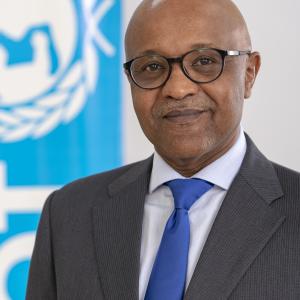
Statement delivered by the Resident Coordinator ad interim, Mr. Osama Makkawi on the occasion of the 77th International Day of United Nations Peacekeepers
On behalf of the United Nations family in Ghana, it is my distinct honor to be part of this solemn observance of the International Day of UN Peacekeepers.
The presence of our men and women in uniform stands as a powerful testament to their indispensable contributions in advancing the cause of peace and security.
For nearly 80 years, United Nations peacekeepers have made a tangible impact on the lives of the communities they serve. They have saved and changed lives in some of the world’s most fragile political and security situations, having helped many countries successfully navigate the difficult path from war to peace.
UN Peacekeepers Day
Today is a moment to pause, recognize and salute the extraordinary peacekeepers serving under the UN flag with a single purpose: to uphold peace where it is most fragile. It is also a moment to pay our respect to the fallen blue helmets, 57 in 2024 alone, including two Ghanaian soldiers Sergeant Evans Kyere and Warrant Officer II (WOII) David Kwame Amankwah, both of whom served with United Nations Interim Security Force for Abyei. In New York, later today, the UN will confer on these fallen heroes the Dag Hammarskjold Medals, a great salutation and recognition for their service, sacrifice and life. May their souls rest in peace. [PAUSE]
Ladies and Gentlemen,
Commemorating Peacekeepers’ Day under the theme, The Future of Peacekeeping: Strengthening Partnership and Multilateralism in Ghana and Beyond, compels us to acknowledge a critical truth: peacekeeping cannot succeed in isolation. It is sustained by unity, strengthened through collaboration, and advanced by multilateral engagement. In a world of evolving security threats, from cyber attacks to climate-driven conflicts and terrorism, bearing the responsibility of peace alone is a herculean task.
Yet, the future demands more than presence and the strength of peacekeepers; it calls for action and intentionality. Building lasting partnerships with others, inside and outside the United Nations system, is essential to respond effectively to collective challenges. Strong, collaborative relationships are essential for bridging the gap between mandates and mission capabilities, ensuring effective performance and addressing drivers of conflict such as climate change, international organized crime, and illegal exploitation of resources.
Strengthening multilateralism also requires deeper collaboration between the United Nations and regional organizations, between peacekeepers and host nations and, most importantly, with local communities.
Indeed as stated by the UN Secretary-General António Guterres at the opening of the 2025 United Nations Peacekeeping Ministerial recently held in Berlin, Germany, “Peacekeeping showcases the power of multilateralism.” Advancing peacekeeping is advancing multilateralism. Therefore, we must commit to making peacekeeping more effective, by
Investing in training and capacity building to equip peacekeepers with modern tools for crisis management; Ensuring sustainable funding so missions have the resources they need to operate efficiently; Elevating the role of women in peace operations; Harnessing technology to enhance the safety of peacekeepers and the impact of the mission; Encouraging regional cooperation for stronger diplomatic interventions before conflicts escalate; and Developing strategies to address new challenges such as cyber warfare, climate-induced conflicts, and terrorism.
Above all, we must invest in long-term peacebuilding efforts that address root causes, promote good governance, and rebuild trust in post-conflict societies.
Ghana and UN Peacekeeping
Ghana has long stood as a steadfast pillar of UN peacekeeping efforts, with a distinguished legacy dating back to the early 1960s. Today, we proudly recognize Ghana’s remarkable contributions, as the nation ranks 7th among 122 troop-contributing countries—a testament to its enduring commitment to global peace and security.
For Ghanaian peacekeepers, this service transcends duty; it is a profound calling to uphold the values of humanity, solidarity, and hope in the world’s most challenging environments. On behalf of the United Nations, I extend our deepest gratitude to the Government and people of Ghana, as well as to the dedicated personnel of our security services and civilian partners, whose sacrifices and unwavering service continue to shape a more peaceful world.
I also want to take this opportunity to congratulate Squadron Leader Sharon Syme of Ghana for receiving the 2024 Military Gender Advocate of the Year Award. We are certainly proud of you and Ghana for your continuous leadership in peacekeeping worldwide.
SG Statement
Before I take my seat, ladies and gentlemen, please permit me to present to you the statement of the United Nations Secretary-General, António Guterres in marking this important day:
“With unwavering courage, United Nations peacekeepers step into danger – to help protect those who need protection, preserve peace, and restore hope in some of the world’s most challenging contexts.
Today, we honour their service.
We draw inspiration from their resilience, dedication and courage.
And we remember all the brave women and men who made the ultimate sacrifice for peace.
More than 4,400 peacekeepers have died in service – 57 last year alone.
We will never forget them – and we will carry their work forward.
The focus of this year’s International Day of Peacekeepers is on “the future of peacekeeping”.
Today, peacekeepers face increasingly complex situations in an increasingly complex world:
Growing polarization and division around the globe …
Operations made even more dangerous from a multiplicity of threats such as terrorism…
Targeting of peacekeepers through deadly misinformation…
And challenges that transcend borders – from the climate crisis to transnational crime.
As we look ahead, it is essential that peacekeepers have what they need to do their jobs.
This is the shared responsibility of the United Nations and Member States.
The Pact for the Future – adopted last year at the United Nations – includes a commitment to adapt peacekeeping to our changing world.
This challenge is also an opportunity:
To analyse what makes peacekeeping operations successful…
To better understand what hinders them…
And to help design new future-focused models that are anchored in political solutions, adequately resourced, and have mandates that are achievable, with clear exit strategies.
The first step – reviewing our peace operations – is underway.
And together, we will keep pushing this vital effort forward.
Now more than ever, the world needs the United Nations -- and the United Nations needs peacekeeping that is fully equipped for today’s realities and tomorrow’s challenges.”
Conclusion
In conclusion, let us collectively reaffirm our unwavering commitment to the principles of peace, multilateral cooperation, and forward-looking solutions.
I thank you all for your dedication to this noble cause, and may our continued partnership bring tangible progress to communities worldwide that yearn for stability and peace.
Thank you.


Speech by
Goals we are supporting through this initiative